Spring 2013
Physics 150-Basic Math
Scientific notation
When dealing with very large or very small numbers, it is much more convenient (and takes a lot less typing) to use scientific notation. Scientific notation takes the form  and the rule is quite simple. If n is positive, move the decimal point n places to the right. If n is negative, move the decimal point n places to the left. When typing, we often abbreviate scientific notation with an "e" instead of the
  . Some examples:




Algebra
We will use the following notation:
 means "x plus y"
 means "x minus y"
 means "x times y"
 means "x divided by y"
 means "x to the y power" or "x times itself y times".
Example: 
 means "the square root of x" and
Geometry and Trigonometry
The figure shows a right triangle. It is a right triangle because one of the angles is  The other two angles are
  and the sides have length a, b, and c.
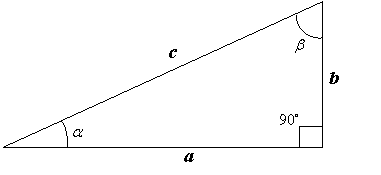 |
We have the following relationships:

Pythagorean Theorem: 
Sine is opposite over hypotenuse:  and
and 
Cosine is adjacent over hypotenuse:  and
and 
Tangent is opposite over adjacent:  and
and 