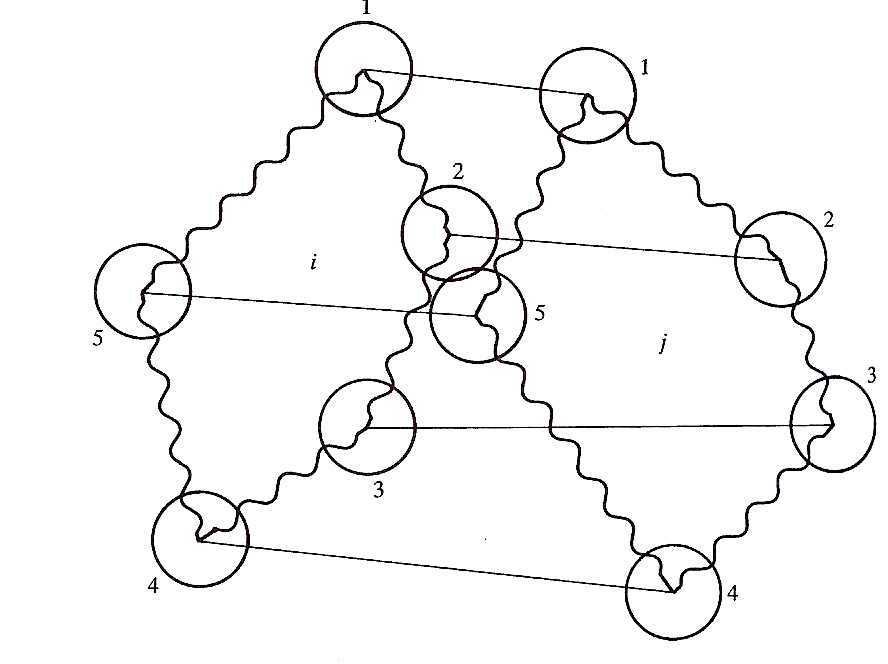
Two particles with five time slices[14].
The path integral monte carlo (PIMC) method maps a quantum many-body system onto a classical system of "ring polymers". This means that we can perform straightforward calculations of quantum mechanical properties.
Each quantum particle corresponds to a ring polymer of N beads, with the quantum kinetic energy corresponding to a harmonic potential between the beads. Each bead on the polymer belongs to a different imaginary time
(temperature) slice. Beads of different atoms on the same time slice interact
via the quantum potential.
Physical quantities are calculated by averaging over the stochastic motion of the polymers using thermodynamic estimators. Often, we are interested in static thermodynamic expectation values:
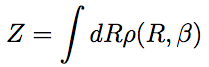

This integral is exact in principle, but we do not know how to calculate the density matrix (ρ) since H is comprised of the non-commuting operators T and V:

Note that (T + V)n cannot be expanded in a binomial series unless the operators commute. To find an explicit form of the density matrix we first will need to introduce a few mathematical identities. From Trotter (1959) the following identity is mathematically rigorous for τ sufficiently small:

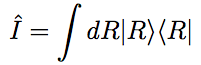
Introducing the position space basis vectors for the quantum Hilbert space ( |R⟩ : ⟨R'|R⟩ = &delta(R - R') ), we have the following representation of the identity operator:
The matrix elements of an arbitrary operator Â; are given by:

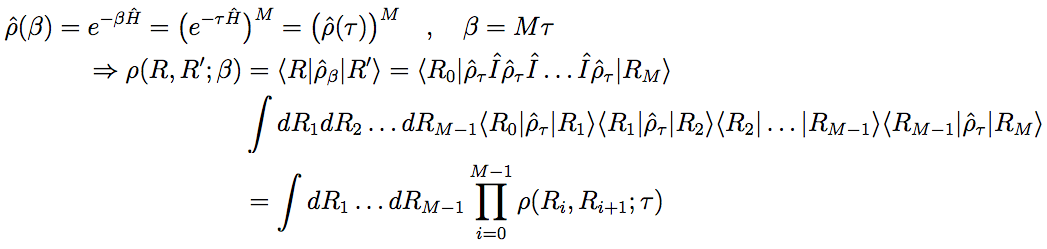
Using these last two identities and setting Β = Mτ , we find:
Now τ is small and we make use of the Trotter formula:
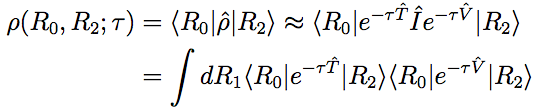
The potential term is:

Recalling that |Ri⟩ is an eigenvector of T, we can also obtain for the kinetic term:

This is done in periodic boundary conditions in the limit that L → ∞. Thus we can find an approximate expression for the high temperature (small τ) density matrix:

All that remains is to perform M - 1 convolutions to obtain the low temperature density matrix:

With this basic approximation, we come full circle back to our ring polymer representation. There are M time slices and N polymers. The motion of beads on one time slice samples one of the integrals in the formula above. Thus as all polymers move, monte carlo integration of the high temperature density matrix is performed and thermodynamic averages can be estimated from the random walk.
*Note: The bra-ket notation symbols on this page appear to only work on Firefox browers, refresh the page if you do not see it in Firefox.
Jaron Krogel, Stefano Markidis, and Henry Wu