
Welcome to Physics 470: Subatomic Physics!
General Overview
The goal of particle physics is to explain the nature of the Universe at its most fundamental level, including the basic constituents of matter and their interactions. The field is currently undergoing a revolution, as understanding of the important role fundamental particles at the tiny scales present in the very early Universe inform our unraveling of the physics of the large scales of today’s Cosmos, and as the world’s highest energy particle collider, the Large Hadron Collider (LHC) begins its scientific program.
Our best theory describing the fundamental particles in Nature and their interactions called the Standard Model:
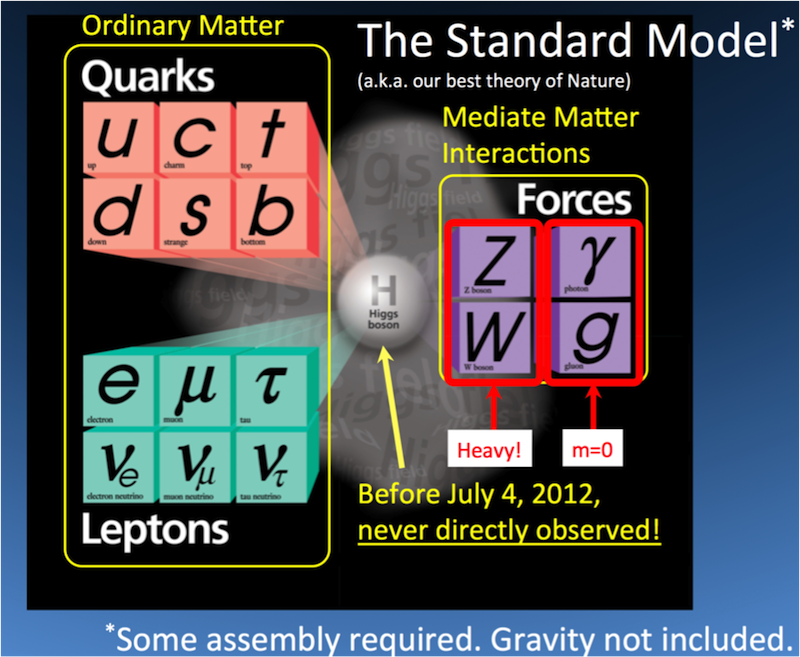
In this course, we will learn about the development of and, to a certain extent, the current state of the Standard Model. At the end of the course, we'll touch on its deficiencies that are the focus of frontier research in particle physics.
I encourage you to ask questions without worrying about whether or not you sound intelligent. I don't promise to have all the answers.
The instruction for this course will begin at 9:30 am on Monday, January 14, 2013 in 136 Loomis Laboratory of Physics (LLP). The complete schedule (subject to change) can be found here.
Syllabus
The syllabus can be found here.Texts
Required
- Griffiths, Introduction to Elementary Particles 2nd Revised Edition
Suggested Supplemental Reading
- Halzen and Martin, Quarks and Leptons.
- Perkins, Introduction to High Energy Physics.
- Aitchison and Hey, Gauge Theories in Particle Physics.
- The Review of Particle Physics, http://pdg.lbl.gov
- J. Hobbs, M.S. Neubauer, S. Willenbrock, Tests of Electroweak Physics at the Energy Frontier, Rev. Mod. Phys 84, 1477 (2012)
- M.S. Neubauer, Diboson Physics at Colliders Physics, Annu. Rev. Nucl. Part. Sci. 61, 223 (2011)
Online access
You can access the gradebook here. Students enrolled in (and staff associated with) the course must log in using their UIUC NetID and their NetID password. If you are enrolled in the course and are having trouble logging in, send email to Rebecca Wiltfong You should always log out of the secure server at the end of your work session.
Lecture notes
Lectures will be held on Mondays and Wednesdays from 9:30-10:50 am in 136 Loomis. Lecture notes will be posted after each lecture at the course website. You will be able to access the lecture notes through the course schedule page.
A .pdf file containing the PHYS 325 (Spring 2010) lectures on special relativity can be found at here.
Homework
Homework is an essential part of this course. The homework to be done will generally be handed out at the end of the each Wednesday lecture. I will collect your solutions at the beginning of lecture typically one week later. Please check the course schedule page for full details. Late work will be marked down by 15% each day that it is late and will not be graded if it is more than one week late. I don't object to people working on the homework problems together as long as the work that you hand in for grading is your own. I strongly recommend that you thoroughly struggle with the problems yourself first. You'll learn more this way and you'll do better on the exams when you're on your own. Trust me on this one.
You will be able to access the homework materials through the course schedule page in case you do not get them in the lecture.
Exams
There will be a midterm exam and a final exam. Dates will be announced. Please check the course calendar for full details.
Office hours
Office hours are on Tuesdays during the following times and in the following locations:
- Mark Neubauer: Wednesdays 11 am - noon in 411 Loomis
- Ching-Kai Chiu: Tuesdays 3 - 4 pm in 3139 ESB
Grading
Your course grade will be based on your homework (~25%), midterm exam (~30%) and final exam (~45%).
Academic Integrity
The giving of assistance to or receiving of assistance from another person, or the use of unauthorized materials during University Examinations can be grounds for disciplinary action, up to and including expulsion from the University.
Please be aware that prior to or during an examination the instructional staff may wish to rearrange the student seating. Such action does not mean that anyone is suspected of inappropriate behavior.
Unless a problem explicitly states otherwise, you are not to use any calculating devices or symbolic manipulation tools in any of your work. No calculators, no computers, no slide rules. And no use of electronic search tools to find material relating to solutions to problems you are working. I will only permit paper and pen, and information you can find in textbooks and reference works such as calculus texts or tables of integrals and special functions. You are on your honor to hold to this.